Thursday, May 15, 2008

Shambhala Sun - Mindfulness, Compassion, & Wisdom, Three Means To Peace

Shambhala Sun - Mindfulness, Compassion, & Wisdom, Three Means To Peace Joseph Goldstein - If our aspiration is peace in the world, is there anyone we would exclude from this wish, whether they are terrorists, suicide bombers, soldiers lost in violence or government policy-makers? "May everyone be free of hatred, free of emnity." These are the mind states that drive harmful acts. If our own response is emnity or hatred or ill will, whether we acknowledge it or not, we are part of the problem... It is not a question of whether unwholesome mind states will arise in us—or in the world around us. Feelings of hatred, emnity, fear, self-righteousness, greed, envy and jealousy all do arise at different times. Our challenge is to see them all with mindfulness, understanding that these states themselves are the cause of suffering and that no action we take based on them will lead to our desired result—peace in ourselves and peace in the world.

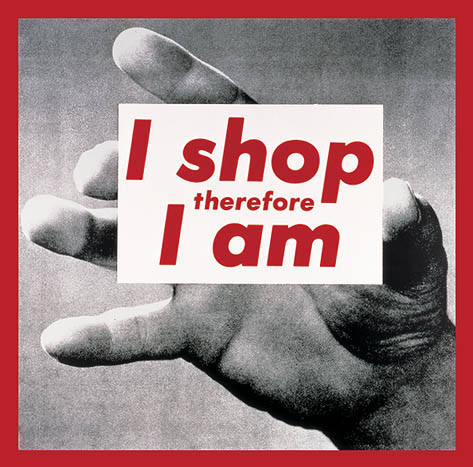
bigger existential supermarkets

"but usually if I'm sitting there without reading, I am a divided person"
 

Yesterday I spent a lot of time reading John Blofeld. He held my attention in Taoist mode and my body and mind were thus calm. Later I did some web design work and that gave some more easy, non-egoic time.

So: cute ways of being non-egoic; noble (?) distractions. Watering the good seeds or at least not watering the bad ones. Keeping the mind free of those negative thought patterns that have become habit energies and which pull me down.

But: the negatives are not to be totally avoided. The idea is to get into a calm and positive frame of mind and then to look into the negative habit energies to see their causes and conditions and thus what lessons might be learned.

There is an enormous existential gulf between 'thinking' and 'noticing what is being thought ': especially when the thought is attached to feelings and thus to body reactions:  and they always are.

Aha: I notice the mind toying with various thought trains but not having decided to fully hop on board any of them. Seemingly spoiled for choice. But it is a limited choice relative to what is truly available. There is the phenomenal v the numinous. More choice of phenomena (bigger supermarkets) - so what? More numinous moments - neat.

Monday, May 05, 2008

Tethering Clouds

George G Clark, 13 April 2008

There is undoubtedly some reality out there: it is, for example, advisable to get out of the way of ten ton trucks. But 'knowing' this reality is a tricky problem.

Most of us have lost touch with our 'beginner's mind'. We rarely indulge in bare sensing of reality; we invariably make the raw 'thing' part of a story where it is linked to all manner of other thoughts and feelings. We elaborate on what we sense in a dynamic and ongoing way. We develop viewpoints and believe that they reflect reality.

"In the beginner's mind there are many possibilities, in the expert's there are few." Suzuki Roshi

But when we make quiet time for deep thought it becomes clear that our viewpoints are as substantial and long lasting as clouds in the sky. But for some (?) reason we prefer to imagine that the cloudy viewpoint has an abiding reality. It is not easy to unhook from this well established habit of thought. But it is well worth the effort; it enables an easy peace. Untether your viewpoints and let them go: you will then be at peace in the present moment. It works for me: more often than not!

Source of viewpoint: Joseph Goldstein (1993) Insight Meditation: the practice of freedom; ISBN 0717122557

"Beginner's mind is Zen practice in action. It is the mind that is innocent of preconceptions and expectations, judgements and prejudices. Beginner's mind is just present to explore and observe and see "things as-it-is."

I think of beginner's mind as the mind that faces life like a small child, full of curiosity and wonder and amazement. "I wonder what this is? I wonder what that is? I wonder what this means?" Without approaching things with a fixed point of view or a prior judgement, just asking "what is it?"

http://www.intrex.net/chzg/hartman4.htm

ten ton trucks

Of ten ton trucks

George Clark 080503

  • Those who know do not speak.
  • Why not?
  • Because they realise that language distorts reality
  • How does it do that?
  • It makes nebulous things too solid
  • What kind of nebulous things?
  • Thoughts and feelings
  • How can they be made too solid?
  • They are in essence subtle and short lived but once they have been trapped in a web of words they take on a kind of 'reality' that they do not really possess
  • I can see that being true for abstract things like truth and beauty but what about ten ton trucks?
  • There is a difference between a ten ton truck as a thing in itself and a ten ton truck as a percept/concept in your mental landscape. 100 people exposed to the same ten ton truck will have 100 perceptions of it.
  • Ah yes: and the perceptions will be vague and passing until they are spoken or written
  • Yup: then the imaginary ten ton truck becomes more real than the physical one
  • Ah yes: and people come to live in a simplified world of imagined things rather than in the world as it is in itself
  • Yup: language constrains consciousness
  • So: those who know do not speak
  • Yup
  • Hmm


Sunday, April 13, 2008

Lecture on Beginner's Mind

Lecture on Beginner's Mind by Blanche Hartman

Saturday, April 12, 2008

touching the earth

Touching the Earth

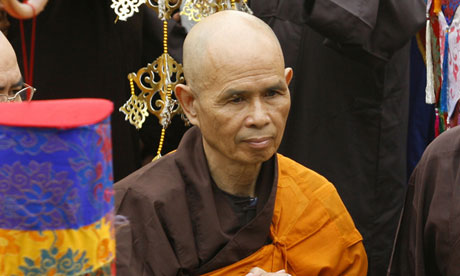
Quotes from Thich Nhat Hahn (2004) ISBN 1888375418

"I have been lucky enough to be instructed in the practice. Yet so often I am just like someone who knows nothing. I walk, stand, speak and smile in forgetfulness. I promise … to do better so that in every moment of my daily life I give rise to more mindfulness and right concentration." (P18)

"Although I have learned of the impermanent nature of everything that is, and I myself have spoken eloquently about it to others, I still have the habit of acting as if everything is permanent and I am a separate self. (p22)

"… you have taught me not to regret the past or lose myself in anxiety and fear about the future. Around me I see many of us who are losing ourselves in our worries and fears. This anxiety stops us from being able to dwell peacefully and live deeply in the present moment. I have the right and ability to make plans for the future, but it is not necessary to lose myself in my worries about it." (p30)

"Practicing mindfulness, I can recognize what is happening in the present without grasping or aversion. I can practice mere recognition of what is going on within me and around me. This helps me to keep stability and freedom alive within myself … When the mental formation of attachment arises I shall be aware that attachment is arising. I shall smile and recognise everything that is happening in the present moment without being anxious or having a complex, whether that complex is one of superiority, inferiority, or equality." (p32)

"I vow that I shall not consume any products that are toxic, whether food or drink, books, magazines, films, music or conversation." (p36)

"… I know that I still have so many wrong perceptions that prevent me from seeing things as they really are. I promise that from now on I shall practice looking deeply to see that the majority of my suffering arises from my ideas and perceptions. I shall not blame others when I suffer, but shall return to myself and recognize the source of my suffering in my misperceptions and my lack of deep understanding. I shall practice looking deeply, letting go of wrong perceptions and helping other people let go of their wrong perceptions so that they can overcome their suffering." (p42)

"Looking deeply I see that there is no phenomenon that is not wonderful: the drop of dew, the blade of grass, the ray of sunlight, a cloud, or a flash of lightning." (p46)

"I promise that I shall organize my daily life so that whenever I need to go somewhere on foot I shall walk mindfully, whether the distance I need to go is near or far. I shall walk mindfully whenever I walk from my bedroom to the bathroom, from the kitchen to the toilet, from the ground floor to the upper floor, from the door to the parking lot. In the forest, by the bank of the river, in the airport, or in the market, wherever I am I shall apply the practice of walking meditation." (p40)

"With mindful breathing I shall look deeply into my perceptions and other mental formations when they manifest. I shall look deeply into their roots so that I can see where they have come from." (p52)

"Many of us are always in a hurry. We hurry to finish one thing to do something else, and one task always follows another. If we have nothing to do we cannot bear it so we fill our time with countless projects and errands. One hundred years flash past like a dream. I do not want to live my life like that. I want to live at ease and deeply every moment of my daily life. I want to practice living happily in the present moment. I want to do less work, and work in such a way that every moment of my work brings me joy." (p78)

"I shall organise my life so that I shall have enough time and energy to cook in a leisurely and peaceful way." (p81)

"I vow to practice living simply, not consuming too much, so that I do not have to spend too much time making a living … I vow not to immerse myself in many different occupations, taking on additional jobs to earn a little bit more money. I vow that I shall not look for  happiness in being busy and consuming." (p83)

Tuesday, April 08, 2008

Mind made:

There is a role for meta thinking and meta feeling: for a leap upwards to generality about process such that all problems are solved in one stroke.

Never mind the details of the problem or issue note only that it is a mind made thing and let it go: whatever it is.

Note the reaction beginning and take time out for a couple of deep breaths. This will prevent the slide down the slippery slope.

And then move on. Do not hang around to gloat about the 'achievement'; go with the flow; move on to the next moment of presence.

One day at a time, one step at a time, one breath at a time.

Sunday, April 06, 2008

push button people

Push button people (for peace?)

George G Clark, 06 April 2008

We all  have buttons which are easily pushed. We have become programmed to think, feel and act this way rather than that. We have fixed viewpoints about many things and we tend to impose our stereotypes and habits on the world. This means that in many ways we are robots – not much more conscious of what is going on than Pavlov's salivating puppies.

The buttons come in a range of sizes and cover all aspects of life. At the top end we have preferences for political party, religious persuasion, and supermarket ambience. At the bottom end we have preferences for ways of taking tea, for which pocket to keep the car keys in, and for which shoe we put on first[1].

The buttons have their causes and conditions. Some are due to our hard wired nature while others are nurtured by our culture and chance personal experiences. Some are of the head while others are of the heart although it is not always easy to split the two. Some appear to the conscious mind but most come from the unconscious such that 'you' do not normally notice them kicking in.

SO, are we doomed to be robots; push button people? The simple answer is NO!

We have the option of being mindful and aware. We can bring the push buttons into the light of conscious awareness and thus be free to break the link between the stimulus and the response. This may be a tough road to travel but it leads to freedom, authenticity and peace.

To practice this kind of freedom you have to make time to notice what is going on in your mind. It is as if there are two yous. One reacts like a conditioned robot while the other watches as a free witness. When the witness is in the forefront of consciousness  there is 'space' where you can consider other viewpoints and possibilities, and where you have the freedom to choose between them.

Freedom means not reacting automatically when a button is pushed. There are two main options for consciously responding. The first  is to notice that the button has been pushed, smile at the situation, and let it go. The second option, if you have the time, is to coolly reflect on the  causes and conditions that link the button to its response; in this way you develop deeper insight into your patterns of conditioning.

This is not an easy road to travel. Your comfort zone will be dis-eased when you upset your routines and habits: at least at first. But the world's  mystical traditions all report that those who push through come to know what Christians call the peace that passes all understanding. This might be  what John Lennon meant when he suggested that we give peace a chance. It is clearly what the Vietnamese Zen Master Thich Nhat Hahn means when he talks of creating true peace:

"Peace is not simply the absence of violence; it is the cultivation of understanding, insight and compassion, combined with action. Peace is the practice of mindfulness, the practice of being aware of our thoughts, our actions, and the consequences of our actions. Mindfulness is at once simple and profound. When we are mindful and cultivate compassion in our daily lives, we diminish violence each day. We have a positive effect on our family, friends and society." (p5)

 This suggests that by taking thought and making an effort we can reprogramme ourselves and become push button people for peace rather than for consumerism and war. How about you, are you going to give peace a chance?


[1] You might like to watch yourself doing ordinary things and noting the habits that are involved eg the pattern of movements as you brush your teeth

Friday, March 28, 2008

no end to flux

No end to flux

George Clark, 28 March 2008

There may have been times and places where people felt that "God's in his Heaven, All's right with the world!". The general world view was robust and reinforced through routines, rituals and stereotypes. There would have been certainty and cognitive closure.

No doubt: stick with tradition.

But, for many people, me included, our post-modern times are not like that. Contemporary free-thinkers are inclined to the view that "the only certainty is doubt" and that "the only constant thing is change". Science no longer deals with "the truth" but rather with "the best working hypothesis in the light of evidence presently available".

Ongoing doubt: go with the flow.

But, for many people, me included, the open, emergent, mode of thinking is tough to deal with. The average human brain seems to need certainty and cognitive closure. One way of managing this is to make a virtue of necessity and to have no doubt about the constancy of change. Some thoughts from holistic systems theory can help with this. The essential idea is that any 'thing' is made up of littler things and is simultaneously part of some bigger thing(s).

Consider the 'thing' which is your human mind. It generates 'meaning' and 'action'. What are the littler 'things' that make it up and what is the greater 'thing' of which it is part?

Your mind creates mental formations as a result of causes and conditions.  The causes and conditions are rooted in instinct, culture or chance; the mental formations have conscious and unconscious components. There is an ongoing internal flux as these littler bits interact  (a) with each other and (b) with the external environment.

And your mind is a small part of that bigger 'thing' which is the external (to you) environment. This has at least two components: the social and the physical.

We are social animals so each individual mind will have causes and conditions that are rooted in its cultural context which has many dimensions: political, economic, spiritual etc. Note that the interactions are two-way: we change the world by our presence while it is changing us.

And we also exist in a physical environment which supplies us with food, clothing and shelter. The interactions are again two-way. We are components of the planet's  living system which interacts constantly with the soil and the climate. We feed on  plants and animals and end up as fertiliser!

Note that the 'things' of systems theory go all the way up and all the way down. We can think in terms of a cosmic zoom.

Going up we have the planet, solar system, universe and the mind blowing concept of an infinite and eternal multiverse which is in an endless state of flux.

Going down we have organs, tissues, cells, molecules, atoms, and then we enter the counter-intuitive quantum world where matter and energy are interchangeable and in endless flux ('thingness' slips through our fingers).

SO – does this help with certainty and cognitive closure on your world view in the post-modern age? Does it help to solidify the flux: if only for a short time?

We can leave the last word to the awe-full Albert Einstein:

"The important thing is not to stop questioning. Curiosity has its own reason for existing. You cannot help but be in awe when you contemplate the mysteries of eternity, of life, of the marvellous structure of reality. It is enough if you try merely to comprehend a little of this mystery every day. Never lose a holy curiosity."